
Why Market Headlines Are a Terrible Investment Strategy
Investors are constantly surrounded by headlines.
Every week there seems to be a new reason markets might struggle. Economic uncertainty, geopolitical conflict, inflation concerns, or changes in interest rates can dominate the news cycle. Financial media often focuses on the immediate impact of these events, which can make markets feel unpredictable and fragile.
History tells a very different story.
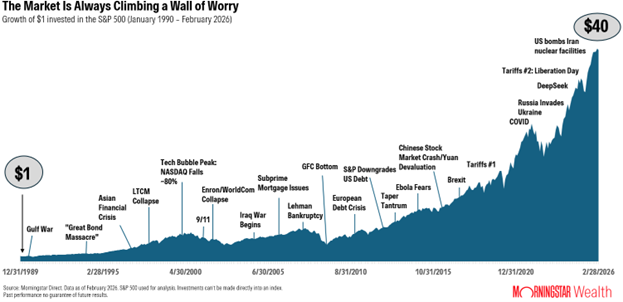
The chart above illustrates what is often referred to as the market’s “wall of worry.” It tracks the growth of $1 invested in the S&P 500 since 1990 while highlighting many of the major crises and headline events that occurred along the way.
Over that period investors experienced events such as:
The Gulf War
The Asian financial crisis
The collapse of Long-Term Capital Management
The tech bubble bursting
9/11
The global financial crisis
The European debt crisis
Brexit
COVID-19
The war in Ukraine
Each of these events created significant uncertainty at the time. In many cases, headlines suggested the economic outlook was deeply concerning or that markets could struggle for years.
Yet despite all of these events, $1 invested in the S&P 500 grew to roughly $40 over that time period.
This does not mean markets move in a straight line. The chart clearly shows periods of volatility and sharp declines. It also shows something equally important. Markets have historically recovered and continued growing over the long term.
This is why making investment decisions based solely on headlines can be risky. Headlines focus on the immediate moment, while markets constantly look ahead. By the time a story dominates the news cycle, markets have often already begun adjusting to the new information.
Investors who react emotionally to each wave of headlines can end up selling during downturns or waiting too long to reinvest once uncertainty fades. Over time, these decisions can cause them to miss periods when markets recover and growth resumes.
Successful investing often looks far less dramatic than the headlines suggest. It typically involves maintaining a long-term perspective, staying diversified, and focusing on a financial plan rather than reacting to every news story.
Markets may always climb a wall of worry, but history suggests that patience and discipline have been powerful tools for investors who stay focused on the long term.
Disclosure: 8818522.1 EXP 3/28